Modern Monetary Theory
A Lens for Understanding Regenerative Monetary Systems
MMT reveals how sovereign currency systems actually work—and how they can be directed toward public purpose, full employment, and sustainable prosperity.

CEO's Guide to Navigating AI Economic Disruption
A 5-part series exploring leadership in the age of artificial intelligence and how regenerative economic principles like MMT provide a framework for navigating disruption.
💡 Click and drag to pan • Scroll to zoom • Double-click to zoom in
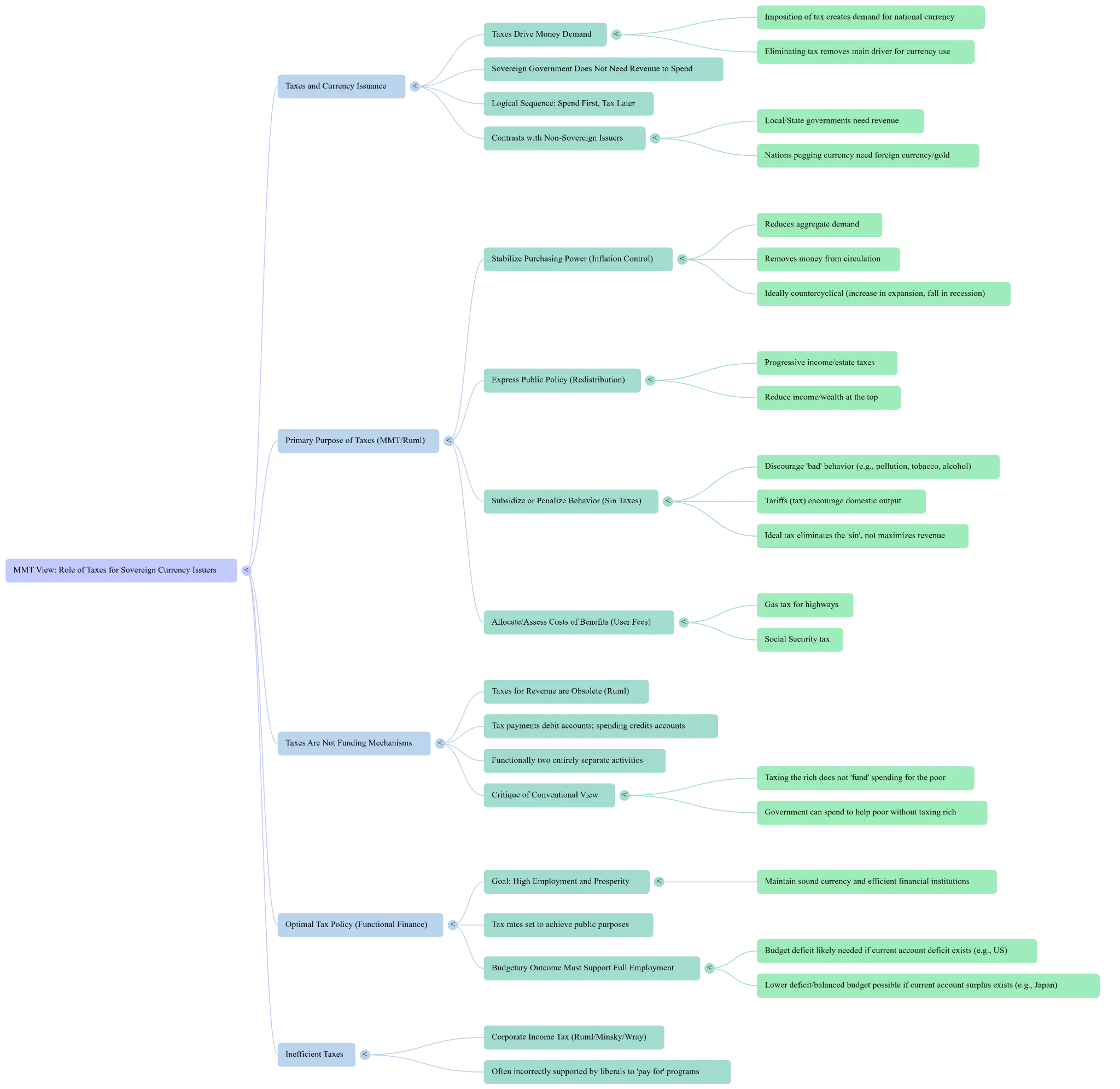
1️⃣ Taxes and Currency Issuance
Taxes Drive Money Demand: Imposing tax obligations creates demand for the national currency. Without taxes, why would anyone need the government's currency?
Eliminating Tax Removes Currency Driver: Tax obligations are the primary mechanism that gives fiat currency its value and utility.
2️⃣ Stabilize Purchasing Power
Inflation Control: Taxes reduce aggregate demand by removing money from circulation, preventing excess demand that drives inflation.
Countercyclical Function: Ideally, taxes increase during economic expansion and fall during recession to stabilize the economy.
3️⃣ Express Public Policy
Redistribution: Progressive income and estate taxes reduce wealth concentration at the top, addressing inequality and concentrated power.
Reduce Income/Wealth at the Top: Taxes can be used to achieve more equitable distribution of resources.
4️⃣ Subsidize or Penalize Behavior
Sin Taxes: Discourage harmful behaviors like pollution, tobacco use, and alcohol consumption.
Tariffs: Can encourage domestic output, though this may not maximize revenue.
Ideal Outcome: The ideal tax eliminates the 'sin' rather than maximizing revenue from it.
5️⃣ Allocate Costs of Benefits
User Fees: Gas taxes for highways ensure users of infrastructure pay for maintenance.
Social Security: Links contributions to benefits received, creating a sense of earned entitlement.
6️⃣ Logical Sequence
Spend First, Tax Later: For sovereign currency issuers, government spending must logically precede taxation. Currency must exist before it can be taxed.
Contrasts with Non-Sovereign Issuers: Local governments and nations pegging their currency need revenue first, but sovereign issuers do not.
🔑 The Central Insight
In a sovereign currency system, taxes are not funding mechanisms. The government creates currency when it spends and destroys currency when it taxes. The real constraint is available resources, not financial resources. This understanding transforms how we think about public policy, deficits, and economic management.
Core MMT Principles
The primary purpose of taxation is to create demand for the sovereign currency. When a government imposes tax obligations that must be paid in its currency, it creates a need for citizens to obtain that currency.
This is the opposite of the conventional view that taxes "fund" government spending.
Governments that issue their own currency (like the US, UK, Japan) are not constrained by revenue. They spend by creating currency, then tax to regulate the economy.
Currency users (households, businesses, local governments) must obtain currency before spending. Currency issuers do not.
For a sovereign currency issuer, government spending logically precedes taxation. The government must first spend currency into existence before it can be used to pay taxes.
This reveals that deficits are not inherently problematic—they represent net financial assets added to the non-government sector.
The optimal tax policy (functional finance) focuses on achieving public purposes like full employment and price stability, not arbitrary deficit or surplus targets.
Budget outcomes should be whatever is necessary to achieve these real economic goals.
Taxes and Currency Issuance
- • Taxes drive money demand: Imposing tax creates demand for national currency
- • Eliminating tax removes main driver for currency use: Without tax obligations, why would anyone need the currency?
Stabilize Purchasing Power (Inflation Control)
- • Reduces aggregate demand: Removes money from circulation
- • Removes money from circulation: Prevents excess demand that drives inflation
- • Ideally countercyclical: Increase in expansion, fall in recession
Express Public Policy (Redistribution)
- • Progressive income/estate taxes: Reduce income/wealth at the top
- • Reduce income/wealth at the top: Address inequality and concentrate power
Subsidize or Penalize Behavior (Sin Taxes)
- • Discourage 'bad' behavior: Pollution, tobacco, alcohol
- • Tariffs tax encourage domestic output: Though this may not maximize revenue
- • Ideal tax eliminates the 'sin': Not maximizes revenue
Allocate Costs of Benefits (User Fees)
- • Gas tax for highways: Users of infrastructure pay for maintenance
- • Social Security tax: Links contributions to benefits received
In a sovereign currency system, taxes are not funding mechanisms. The government does not need to collect taxes before it can spend. This is the fundamental insight that distinguishes MMT from conventional economic thinking.
The Conventional View (Incorrect for Currency Issuers):
"Government must tax or borrow before it can spend. Deficits are inherently problematic and must be minimized."
The MMT View (Correct for Currency Issuers):
"Government spending creates currency. Taxes destroy currency. The deficit is simply the accounting record of net currency creation, which adds financial assets to the non-government sector."
This doesn't mean deficits don't matter—they matter for their real economic effects (inflation, resource allocation, distribution). But the constraint is real resources, not financial resources.
Contrasts with Non-Sovereign Issuers
Local and state governments are currency users, not issuers. They must obtain revenue through taxes or borrowing before they can spend. For them, the conventional view is correct.
Countries that peg their currency to gold or foreign currency are also constrained by revenue. They need to acquire the asset they've pegged to before they can expand their money supply.
Corporate Income Tax (Rumi-Minsky-Wray)
Often incorrectly supported by liberals to "pay for" programs. In reality, it may be passed on to consumers or discourage investment without achieving progressive redistribution.
Taxes for Revenue as Obsolete (Rumi)
For sovereign currency issuers, the idea that taxes fund spending is obsolete. This misconception leads to:
- • Tax payments debt accounts; spending credits accounts
- • Functionally two entirely separate activities
Critique of Conventional View
The conventional view leads to unnecessary austerity, underinvestment in public goods, and the false belief that government spending "crowds out" private investment. In reality, government spending can enable private investment by creating demand and building infrastructure.
The goal of tax policy in a regenerative monetary system is not to "balance the budget" but to achieve real economic objectives:
High Employment and Prosperity
Maintain sound currency and efficient financial institutions to enable full employment without inflation.
Tax Rates Set to Achieve Public Purposes
Adjust tax rates based on their real effects, not arbitrary fiscal targets.
Budgetary Outcome Must Support Full Employment
Whether deficit or surplus, the budget should deliver full employment and price stability.
Lower Deficit Balanced Budget Possible
If current account surplus exists (e.g., Japan), lower deficits may be appropriate. But this is context-dependent.
The key insight: Budget deficit likely needed if current account deficit exists (e.g., US). This is not a problem—it's the natural outcome of sectoral balances in an open economy.
Learn More About Regenerative Systems
MMT is just one lens for understanding regenerative economics. Explore other domains where regenerative thinking is transforming our world.